
The author E.F. Schumacher moved from Germany to England in 1930 to study economics at Oxford. At the age of 22, he himself became a teacher of economics at Columbia University in New York. However, he did not stay for long because he wanted to get away from theorizing and acquire practical knowledge. He came to try life as a journalist, farmer and businessman. Later he returned to the academic world for a period, but his main work was as an advisor to governments around the world. He was also a prolific writer for several newspapers (for a period in his youth he also worked for the British National Coal Board, where he, if I got it right, advocated a transition from oil to coal as the main source of energy).
The book Small is beautiful. Economics as if people mattered was published in 1973. Schumacher was in his work inspired by John Maynard Keynes, but was also influenced by Buddhism, Mahatma Gandhi, Karl Marx, John Ruskin, etc., and by small-scale economics in many of the third world countries he visited.
In Small is beautiful he writes critically about how technology and economics have been allowed to steer our societies away from what is actually functional, from a human point of view. We confuse the concepts of natural capital and income, and thereby treat nature as if finite resources were infinite. We are estranged from nature and only value what we ourselves have created (here Schumacher is critical of Marx, who he believes falls into precisely that trap).
“To the extent that economic thinking is based on the market, it takes the sacredness out of life, because there can be nothing sacred in something that has a price.”
Fossil fuels are just one of the natural resources that we handle recklessly as a result: “Fossil fuels are merely a part of the natural capital which we steadfastly insist on treating as expendable, as if it were income, and by no means the most important part. If we squander our fossil fuels, we threaten civilization; but if we squander the capital represented by living nature around us, we threaten life itself.”
What he is saying is that an activity can be counted as “economic” even though it wrecks the environment.
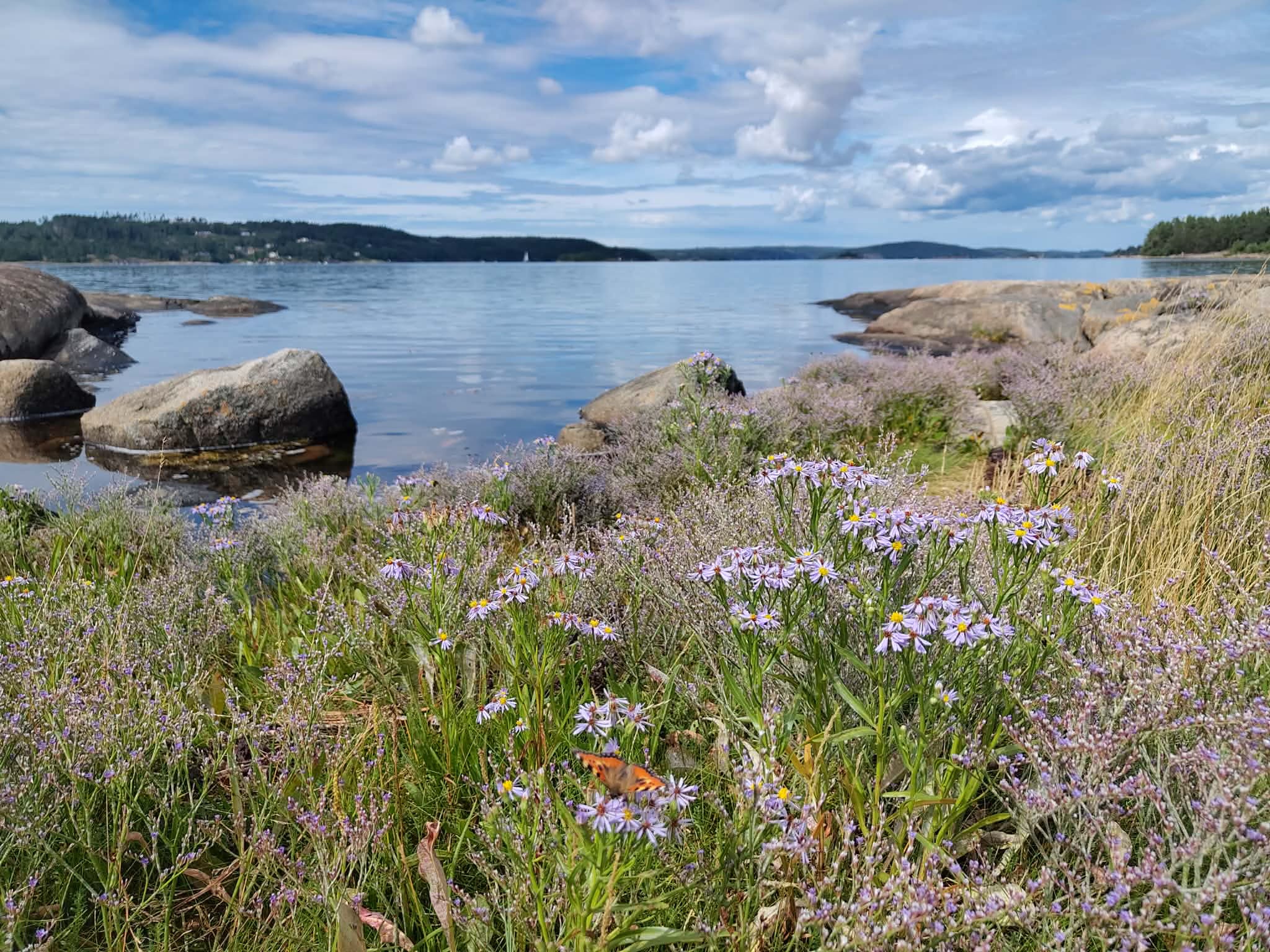
Nature, not to be wrecked. A silver-washed fritillary (the butterfly) in seashore aster, close to where I live.
Economics, Schumacher writes, deals with goods in accordance with their market value and not in accordance with what they really are. All goods are treated the same. The same rules and criteria are applied to “primary goods”, which one has to win from nature, and “secondary goods”, which presuppose the existence of primary goods and are manufactured from them. This happens because the goal of our society is that of private profit making. it is inherent in the methodology of western economics to ignore man’s dependence on the natural world, writes Schumacher. “To the extent that economic thinking is based on the market, it takes the sacredness out of life, because there can be nothing sacred in something that has a price.” But since consumption is merely a means to human well-being, the aim should be to obtain the maximum of well-being with a minimum of consumption. Over-consumption is a form of violence in the world we live in.
The economic religion we live by has as its first commandment to behave economically and our desires are insatiable, Schumacher notes:
“There are poor societies which have too little; But where is the rich society that says: halt! We have enough? There is none.” And here I would like to add that we constantly confuse “need” and “desire”. We claim to “need” a lot of things, but almost always we should instead change the words we use and say it as it is, we don’t need, we desire. “Permanence is incompatible with the predatory attitude which rejoices in the fact that what were luxury’s for our fathers have become necessities for us”.”
The economy must serve people and nature, otherwise it is useless to us. We live our lives in small contexts, which is why economics and economic “science” need to adapt to them: “If economic thinking cannot grasp this it is useless. If it cannot get beyond its vast abstractions, the national income, the rate of growth, capital/output ratio, input-output analysis, labour mobility, capital accumulation; if it cannot get beyond all this and make contact with the human realities of poverty, frustration, alienation, despair, breakdown, crime, escapism, stress, congestion, ugliness and spiritual death, then let us scrap economics and start afresh. Are there not indeed enough signs of the times to indicate a new start is needed?”
The economy should serve man and nature, not the other way around.
Part of what Schumacher writes about has a direct bearing on technology development in AI today: He refers to Gandhi who used to talk disparagingly of dreaming of systems so perfect that no one will need to be good: “But is it not precisely this dream which we can now implement in reality with our marvelous powers of science and technology? Why ask for virtues, which man may never acquire, when scientific rationality and technical competence are all that is needed?”
We instrumentalize what cannot be instrumentalize without totally loosing its meaning. And here is another quote about our view of technology as a solution to most things, as well as to the problems that technology itself has created:
“The new problems are not the consequences of incidental failure but of technological success. Here again, however, many people will insist on discussing these matters solely in terms of optimism and pessimism, taking pride in their own optimism that science will find a way out. They could be right only, I suggest, if there is a conscious and fundamental change in the direction of scientific effort. The developments of science and technology over the last 100 years have been such that the dangers have grown even faster than the opportunities.”
“More education can help us only if it produces more wisdom.”
We cannot solve the problems that technology has created with even more technology, but yet we are putting all our hopes to technological solutions, and will end up making even more damage to the natural systems we depend upon. It is the system that is the problem, and nature that is the solution.
We have built a society that is driven forward by greed and envy, says Schumacher. Our ever-increasing desires and wants are encouraged by the economic system and constitute an antithesis to wisdom, freedom and peace: “Every increase of needs tends to increase one’s dependence on outside forces over which one cannot have control, and therefore increases existential fear. Only by a reduction of needs can one promote a genuine reduction in those tensions which are the ultimate causes of strife and war.”
In other words: we need to get better at being satisfied with what we have.
Some more perfect one-liners (or two- to three-) from Small is beautiful:
“The richer the society, the more impossible it becomes to do worthwhile things without immediate payoff.”
“At present there can be little doubt that the hole of mankind is in mortal danger, not because we are short of scientific and technological know-how, but because we tend to use it destructively, without wisdom. More education can help us only if it produces more wisdom.”
“in our time, the main danger to the soil, and therewith not only to agriculture but to civilization as a whole, stems from the townsman’s determination to supply to agriculture the principles of industry.”
“Health beauty and permanence are hardly even respectable subjects for discussion, and this is yet another example of the disregard of human values, and this means a disregard of man, which inevitably results from the idolatry of economism.”
“So this is the first question I suggest we have to face. Can we establish an ideology, or whatever you like to call it, which insists that the educated have taken upon themselves an obligation and have not simply acquired a passport to privilege?”
“The right thing to do is what is right for the forest and the land.”
This summer I also read Kim Stanley Robinson’s The ministry for the future. It too left my hands with many underlines. I love how he gives voice to a multitude of people, animals, nature and phenomena. The atom gets its own voice, as does the market and the globe as such. I love how he tries to write out solutions and not just depict the misery that awaits if we don’t act.
We need more utopias that help us imagine a better world, not just dystopias that give us terrifying visions of the future. I don’t think Robinson is as good at one-liners as Schumacher but I appreciate a recurring phrase. With reference to Aldo Leopold, the actors in the book are driven by the motto “The right thing to do is what is right for the forest and the land.” Add “water” to that short list, and it says everything about how we should prioritize in politics going forward.